
MileTrack Blog
Mileage Tracker With No Account: Trip Data That Stays on Your iPhone
An account is the dividing line: it is what moves your trip history to a vendor server and ties its retention to a subscription. The five App Store privacy labels, side by side.
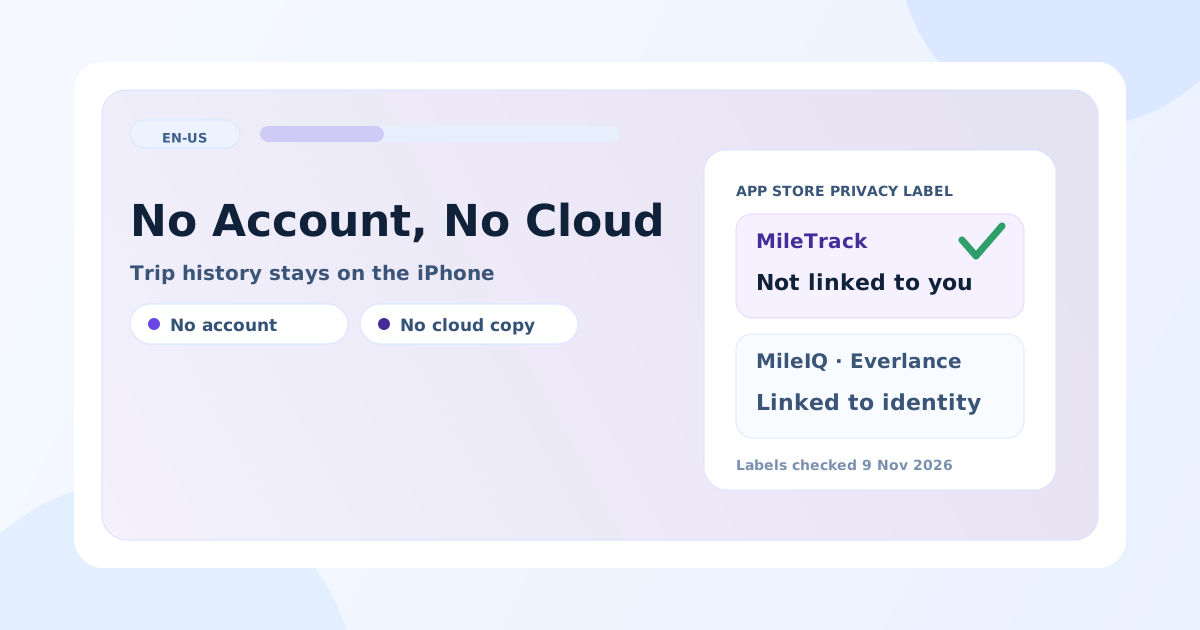
Two of the five best-known iPhone mileage trackers declare “Data Not Linked to You” on their App Store privacy label; the other three declare your location, contact info and identifiers linked to your identity, and two of those also declare data used to track you across other companies’ apps. That is the whole decision, and Apple publishes it for free on every app’s page.
The word the market hides it behind is “account”. An account is not a convenience feature — it is the mechanism that moves your trip history onto a vendor’s server, ties its retention to whether you are still paying, and makes a privacy label say “linked to your identity”. This page compares what the five apps declare, what MileTrack gives up by asking for no account at all, and how to check any other app yourself in two minutes.
What the App Store privacy labels say
Apple requires every developer to declare which data the app collects and whether it is linked to your identity. These are the five labels as published on 9 November 2026:
| App | Privacy label category | What is declared | Tracking across other companies’ apps |
|---|---|---|---|
| MileTrack | Data Not Linked to You | Location, Identifiers, Usage Data | None declared |
| TripLog | Data Not Linked to You | Identifiers, Usage Data, Diagnostics | None declared |
| Driversnote | Data Linked to You | Health & Fitness, Location, Contact Info, Identifiers, Usage Data, Diagnostics | None declared |
| MileIQ | Data Linked to You | Financial Info, Location, Contact Info, User Content, Identifiers, Usage Data, Diagnostics | Yes — Usage Data |
| Everlance | Data Linked to You | Health & Fitness, Financial Info, Location, Contact Info, User Content, Identifiers, Usage Data, Diagnostics, Other Data | Yes — Contact Info, Identifiers, Usage Data |
Two things are worth reading twice. Location linked to identity is the one that matters for a mileage app: a list of every place you stopped, attached to your name and email. And a label is the developer’s own declaration, not an audit — it is evidence, not proof.
The download sizes line up with the same split: MileTrack is 39.9 MB, TripLog 149.2 MB, Driversnote 113.1 MB and Everlance 195.1 MB. An app that does not carry an account system, a web client and an analytics stack is a smaller app.
Why the account is the dividing line
A cloud account buys four things, and costs four others.
What it buys: a copy of your log if the phone is lost, the same log on a second device, a browser window for bulk editing, and an admin view if someone else needs your mileage.
What it costs:
- Retention follows the subscription. When the paid plan lapses, the log is on someone else’s server under someone else’s terms. Export before you cancel, not after.
- Location joins your identity. That is what three of the five labels above declare.
- An export can sit behind a paywall. Recording is the cheap part for a vendor; retrieving a finished report is the part worth charging for. Free mileage tracker apps goes through where each free tier actually draws the line.
- A second party holds the evidence. For an audit that is neutral; for a client list it may not be.
Free-tier caps and prices, checked the same day
The privacy split and the price split are not the same split, so here are both:
| App | Free tier | Paid plan | Account required |
|---|---|---|---|
| MileTrack | Unlimited automatic trips, unlimited PDF, CSV and XLSX exports | None — free in the current beta, and that it stays free is not promised | No |
| MileIQ | 40 drives per month | $11.66 a month billed annually ($139.92 a year) | Yes |
| Driversnote | Reporting for up to 15 trips a month | $11 a month; iBeacon included with an annual plan ($40 value) | Yes |
| Everlance | 30 automatically tracked trips a month, unlimited manual | $89.99 a year (Starter) or $119.99 a year (Professional) | Yes |
| TripLog | Free-forever tier; unlimited reporting is paid | $4.99 a month billed annually ($59.99); 7-day pass also sold | Yes |
What still leaves the phone, honestly
“On-device” is a claim worth testing rather than trusting, including ours. With MileTrack:
- Trip detection and the trip database are on the iPhone. Nothing is hosted on MileTrack servers in the current beta.
- Apple’s mapping services are reached in real time when you explicitly search an address, preview a route, move a pin, use Look Around or open a map view. Those are requests you make, not a background upload.
- Your own iPhone backup is still a backup. If iCloud Backup is on, the app’s data is in it, under Apple’s terms, not ours.
- There is no sync. Two phones means two separate logs. Moving to a new phone means an iPhone backup restore, and the safe habit is a quarterly export either way.
Where the others still win
- Android and the web. MileTrack is iPhone-only for now; all four competitors run on Android, and three have a browser dashboard.
- Teams. MileIQ for Teams, Everlance and TripLog collect logs across employees and reimburse from them. MileTrack does not attempt it.
- Accounting integrations. TripLog publishes the widest list — QuickBooks Online, SAP Concur, ADP, Paychex and more. MileTrack exports a file and leaves the import to you.
- Expenses and income. Everlance and Hurdlr track mileage next to receipts and earnings; MileTrack tracks mileage only.
- A long rating history. MileIQ has over 115,000 US ratings, Everlance over 53,000, Driversnote over 39,000, TripLog over 4,700. MileTrack has a handful. If a long public track record is what you need, that is an honest reason to pick one of them.
How to check any mileage app in two minutes
- Open its App Store page and scroll to App Privacy. If the label says location is linked to your identity, the log is on a server with your name on it.
- Install it and watch the first screen. If it asks for an email before it will record anything, your trips are going somewhere.
- Try one export before paying. If the PDF or CSV is paywalled, the free tier is a recording service, not a mileage log.
- Put the phone in airplane mode and drive. An app that detects nothing without a network is doing the detection on a server.
Does the IRS care where the log lives?
No. Publication 463 asks for records that establish the mileage, date, destination and business purpose of each trip, written down close to the time of the drive. Storage location is not one of the requirements — a PDF exported from the phone and filed with the rest of your return is a complete record. The requirement that does bite is retention: keep it for three years after you file the return that uses it, which how long to keep mileage records breaks down case by case. For the fields the export must carry, see mileage log requirements.
MileTrack is free on the App Store — no account, no card, trip history on the iPhone. For the wider comparison including paid apps, see the best mileage tracker app for taxes, and for the MileIQ free cap specifically, the MileIQ alternative guide.
Tax note: this article is general orientation, not tax advice. Privacy labels and prices verified 2026-11-09 — check the linked official pages before deciding.
Freshness note
Privacy labels read from each app's US App Store page on 2026-11-09; free-tier caps and prices read from each vendor's own pricing page the same day. Labels are the developer's own declaration, not an audit, and vendors change both labels and plans — check the linked pages before deciding. MileTrack is our own product, which is why this comparison also states plainly what it gives up.
Official sources
Stop rebuilding your mileage log by hand
MileTrack detects your drives automatically, keeps business, commute, and private separate, and exports IRS-ready PDF, CSV, and XLSX. Free on iPhone, no account needed.
Automatic mileage tracking with no account and no card — trip history stays on your iPhone.
Get MileTrack freeFAQ
Is there a mileage tracker app that works without an account?
Yes. MileTrack asks for no account, no email and no card — you install it, grant motion and location permission, and the first drives are detected automatically. Trip history, saved places, vehicles and reports stay on the iPhone, and the PDF, CSV and XLSX exports are free. The cost of that design is that there is no sync between devices and no web dashboard.
Which mileage tracker keeps my location data on the device?
MileTrack stores trip history on the iPhone by default and hosts none of it on its own servers in the current beta. On Apple's privacy labels it declares location, identifiers and usage data as "Data Not Linked to You". TripLog declares identifiers, usage data and diagnostics in the same category but requires an account, so the log itself does leave the phone.
Does a mileage log have to be stored in the cloud to satisfy the IRS?
No. Publication 463 asks for a record that gives the mileage, date, destination and business purpose of each trip, kept in a timely manner. It says nothing about where the file lives. A PDF or spreadsheet exported from your phone and kept with the rest of your tax records meets the requirement; keep it for three years after you file the return that uses it.
Does a mileage tracker work without an internet connection?
Recording does. Trip detection on the iPhone runs on the phone's own motion and location sensors, so drives through a dead zone or in airplane mode are still captured. What needs a connection is turning coordinates into street names: addresses, route previews and map views reach Apple's mapping services when you ask for them, and fill in later if you were offline.
What do I give up by choosing a tracker with no account?
Four things, and they are real. No sync to a second phone, tablet or laptop. No web dashboard for bulk editing. No admin collecting logs across a team. And no vendor-side copy: if the phone is lost and you have no backup, the log is gone, so export at least once a quarter.