MileTrack Blog
Mileage Rates in Europe 2026: Complete Guide for Business Travelers
Side-by-side comparison of 2026 mileage rates in 23 European countries — from Norway's NOK 3.50/km to Cyprus's €0.25/km — plus compliance rules for cross-border business travel.
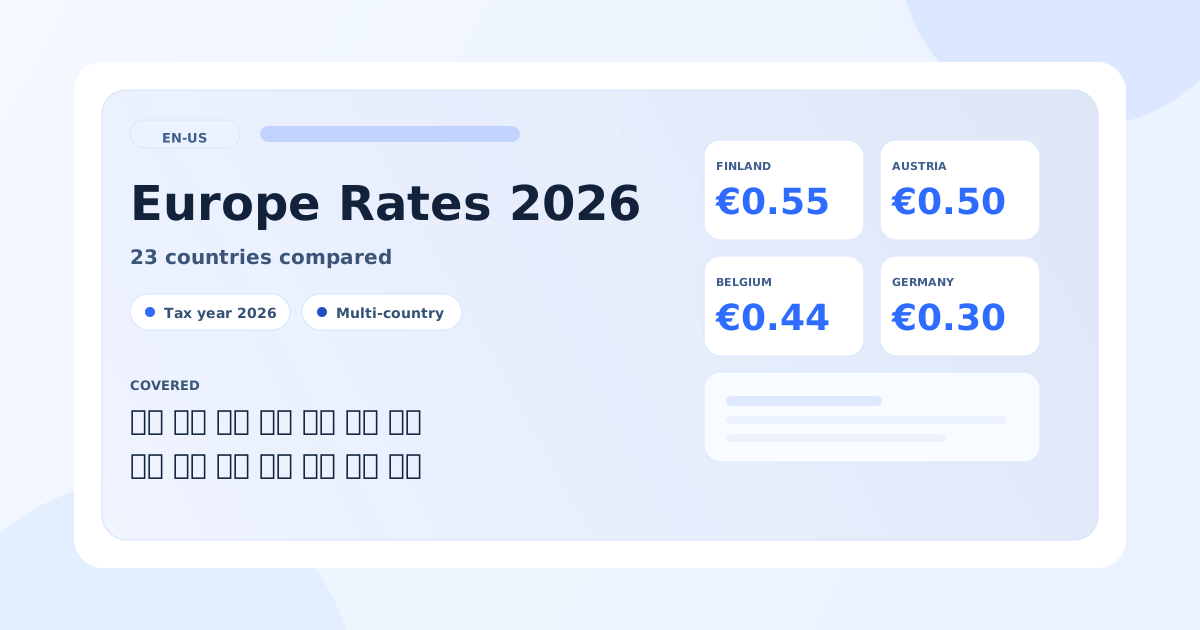
Europe has no single mileage reimbursement standard. Each country sets its own rules — some publish a clean per-kilometre figure, others use tiered brackets that change at a distance threshold, and a few base the amount on your engine size or fiscal horsepower. The result is a patchwork: Finland reimburses employees at €0.55/km while Cyprus caps it at €0.25/km. A business traveller driving the same route through three countries may technically fall under three different rate regimes.
This guide collects the official 2026 mileage rates for 23 European countries, explains how each rate model works, highlights the biggest compliance traps around commuting, and compares the European landscape to the IRS Mileage Rate 2026 for US-based readers.
Full comparison: 2026 mileage rates across Europe
The table below lists every country alphabetically within each rate-model group. Where a country uses a tiered or formula-based system, the “Rate” column shows the primary tier or the most common bracket. The “EUR Equivalent” column converts non-euro rates at approximate March 2026 exchange rates.
| Country | Code | Rate | Currency | EUR Equiv. | Rate Model | Official Source |
|---|---|---|---|---|---|---|
| Finland | FI | 0.55 | EUR | €0.55 | Flat | Vero.fi |
| Austria | AT | 0.50 | EUR | €0.50 | Flat | BMF Austria |
| Croatia | HR | 0.50 | EUR | €0.50 | Flat | Porezna uprava |
| Belgium | BE | 0.4449 | EUR | €0.4449 | Flat (annual adj.) | BOSA Belgium |
| Portugal | PT | 0.40 | EUR | €0.40 | Flat | DRE Portugal |
| Iceland | IS | ISK 335 | ISK | ≈€0.39 | Flat | Skatturinn |
| Luxembourg | LU | 0.38 | EUR | €0.38 | Flat | Impôts directs |
| Estonia | EE | 0.37 | EUR | €0.37 | Flat | EMTA |
| Switzerland | CH | CHF 0.70 | CHF | ≈€0.37 | Flat | ESTV |
| Germany | DE | 0.30 | EUR | €0.30 | Flat | BMF LStH 2026 |
| Spain | ES | 0.26 | EUR | €0.26 | Flat | BOE |
| Cyprus | CY | 0.25 | EUR | €0.25 | Flat | Cyprus Tax Dept. |
| Norway | NO | NOK 3.50 | NOK | ≈€0.30 | Flat | Skatteetaten |
| Netherlands | NL | 0.23 | EUR | €0.23 | Flat | Belastingdienst |
| UK | GB | £0.45/£0.25 | GBP | ≈€0.53/€0.29 | Tiered at 10,000 mi | HMRC |
| Denmark | DK | DKK 3.94/2.28 | DKK | ≈€0.53/€0.31 | Tiered at 20,000 km | SKAT |
| Sweden | SE | SEK 2.50 | SEK | ≈€0.22 | Flat | Skatteverket |
| France | FR | Formula | EUR | Varies | Fiscal HP formula | Service-public.fr |
| Italy | IT | Formula | EUR | Varies | ACI cost tables | ACI |
| Ireland | IE | Tiered | EUR | €0.28–€0.74 | Engine cc + distance | Revenue.ie |
| Poland | PL | PLN 0.89 | PLN | ≈€0.21 | Engine capacity | ISAP |
| Czech Republic | CZ | CZK 5.60 | CZK | ≈€0.22 | Flat + fuel reimb. | Czech Min. of Labour |
| US (ref.) | US | $0.74/mi | USD | ≈€0.43/km | Flat (per mile) | IRS |
Rates are for standard passenger cars (own vehicle used for business). Where a country publishes separate motorcycle or bicycle rates, only the car rate is shown. Exchange rates are approximate as of March 2026.
The five highest rates in Europe
If you rank by the absolute per-kilometre amount in euros, five countries stand well above the rest.
1. Finland — €0.55/km
Finland’s rate is the highest flat per-kilometre reimbursement in Europe. The Finnish Tax Administration (Vero) updates it annually. The rate covers all vehicle operating costs and applies uniformly — no engine-size brackets, no distance tiers. Employers can reimburse up to this amount tax-free; anything above is taxable income.
2. Austria — €0.50/km
Austria’s Kilometergeld of €0.50 applies to employees using their own car for business trips. The Austrian Federal Ministry of Finance publishes separate rates for motorcycles (€0.24) and bicycles (€0.38). The car rate has remained stable since 2023, making Austria one of the most generous flat-rate countries in the eurozone.
3. Croatia — €0.50/km
Croatia matches Austria at €0.50/km for tax-free employer reimbursement. The rate was revised when Croatia adopted the euro in January 2023 and has been maintained through 2026. The Croatian Tax Administration publishes the full schedule of non-taxable employee payments.
4. Belgium — €0.4449/km
Belgium recalculates its rate annually using a formula tied to the consumer price index. The 2026 figure of €0.4449 was published in the Belgian Official Gazette. This mechanism means Belgium’s rate tracks inflation more closely than most countries, and it can move in either direction year to year.
5. Portugal — €0.40/km
Portugal’s flat €0.40/km is defined by decree and applies to public-sector employees — but in practice it serves as the benchmark for private-sector reimbursement policies too. The current rate is published in the Diário da República.
Flat rate vs tiered vs formula-based models
European mileage systems fall into three broad categories. Understanding which model a country uses is essential for accurate reimbursement.
Flat rate (most countries)
The majority of European countries set a single per-kilometre amount that applies to every business kilometre equally. Germany (€0.30), Spain (€0.26), the Netherlands (€0.23), Finland (€0.55), Austria (€0.50), Estonia (€0.37), Portugal (€0.40), and Norway (NOK 3.50) all use this model.
Flat rates are straightforward to implement: multiply business kilometres by the published rate. The simplicity makes compliance easy but means the rate may over-reimburse short trips and under-reimburse long ones.
Tiered (UK, Denmark, Ireland)
Tiered systems change the per-unit rate after a distance threshold.
United Kingdom: HMRC’s Approved Mileage Allowance Payments (AMAP) set 45 pence per mile for the first 10,000 business miles and 25 pence per mile thereafter. For an employee driving 14,000 business miles in 2026:
- First 10,000 miles: 10,000 x £0.45 = £4,500
- Next 4,000 miles: 4,000 x £0.25 = £1,000
- Total tax-free reimbursement: £5,500
Denmark: SKAT publishes DKK 3.94/km for the first 20,000 km and DKK 2.28/km beyond that. An employee driving 25,000 business km:
- First 20,000 km: 20,000 x DKK 3.94 = DKK 78,800
- Next 5,000 km: 5,000 x DKK 2.28 = DKK 11,400
- Total: DKK 90,200 (approximately €12,100)
Ireland: Revenue uses a matrix based on engine capacity and total annual distance, with rates ranging from €0.28 to €0.74 per km depending on the bracket. A 1.5L engine car in the 0–6,437 km band gets the highest rate.
Formula-based (France, Italy)
France and Italy do not publish a single per-km number. Instead, the reimbursement depends on the specific vehicle.
France: The barème kilométrique uses fiscal horsepower (CV fiscaux) and annual distance to calculate the deduction. A 6 CV vehicle driven 15,000 km yields a different per-km effective rate than a 4 CV vehicle driven 8,000 km. There is no single “French mileage rate.”
Italy: The ACI cost tables publish per-km operating costs for every make and model sold in Italy. An employer reimbursing at or below the ACI figure for the employee’s specific car model can do so tax-free. This gives precision but requires knowing the exact vehicle.
Commuting rules: the biggest compliance trap
The treatment of commuting — driving between home and a regular workplace — is where most cross-border errors occur. Some countries allow it, some prohibit it, and others handle it through a completely separate tax mechanism.
| Treatment | Countries | Notes |
|---|---|---|
| Not deductible | UK, Spain, Italy, Ireland, France, Croatia, Portugal, Cyprus | Ordinary home-to-office travel is personal |
| Separate allowance | Germany, Austria, Belgium, Luxembourg | DE uses Entfernungspauschale (€0.30/km one-way, €0.38 above 21 km); AT uses Pendlerpauschale |
| Allowed tax-free | Netherlands, Estonia | NL: employer can reimburse commute at €0.23/km tax-free; EE: flat rate covers all |
| Policy-dependent | Sweden, Switzerland, Denmark, Iceland | Deductible if distance/time thresholds met or employer policy permits |
| Separate deduction | Norway, Finland | NO: commuting deductible above NOK 14,950 threshold at NOK 1.76/km; FI: deductible with caps |
The key trap: Germany’s €0.30/km business mileage rate and its Entfernungspauschale (commuting allowance) are two entirely different mechanisms. The business rate applies to actual business travel. The commuting allowance is a flat deduction of €0.30 per km of one-way commute distance (€0.38/km from the 21st km onward), regardless of transport mode. Confusing the two — or applying the business rate to commuting — is a common error in cross-border payroll.
How European rates compare to the US IRS rate
The US standard mileage rate for 2026 is $0.74 per mile. Converted to kilometres, that is approximately $1.16/km, or roughly €1.07/km at current exchange rates. This makes the US rate more than double the highest European flat rate (Finland’s €0.55/km) when measured in the same units.
However, the comparison is misleading without context:
- US rate is a deduction, not a tax-free reimbursement. Self-employed taxpayers subtract it from gross income on Schedule C. W-2 employees cannot deduct mileage at all since 2018.
- Most European rates are employer reimbursements. The employer pays the amount tax-free to the employee. It reduces the employee’s out-of-pocket cost directly.
- US rate bundles more costs. The IRS rate is designed to cover fuel, depreciation, insurance, maintenance, and registration. Some European rates are narrower in scope, with separate allowances for tolls, parking, or vehicle wear.
- Higher US vehicle costs. Average fuel prices, insurance premiums, and depreciation in the US (particularly for the larger vehicles common there) justify a higher per-unit figure.
For a detailed breakdown of the US rate, including worked examples and filing workflows, see IRS Mileage Rate 2026.
Worked example: same trip, different countries
An employee drives 800 km for business in a single month. Here is what the tax-free reimbursement looks like under different country rates:
| Country | Rate | Reimbursement |
|---|---|---|
| Finland | €0.55/km | €440.00 |
| Austria | €0.50/km | €400.00 |
| Belgium | €0.4449/km | €355.92 |
| Germany | €0.30/km | €240.00 |
| Spain | €0.26/km | €208.00 |
| Netherlands | €0.23/km | €184.00 |
| Sweden | SEK 2.50/km | SEK 2,000 (≈€183) |
| UK | £0.45/mi (≈£0.28/km) | £224 (≈€263) |
| US | $0.74/mi (≈$0.46/km) | $368 (≈€339) |
The spread from highest to lowest among European flat rates is more than 2:1. An employee driving the same distance receives €440 in Finland but only €184 in the Netherlands.
Cross-border compliance tips
Business travel across European borders raises practical questions about which rate applies and what documentation is needed.
Which rate applies?
The general principle: the mileage rate of the country of employment (where the employee is tax-resident and employed) applies to all business travel, including travel in other countries. A German employee driving to a meeting in Belgium claims €0.30/km under German rules, not Belgium’s €0.4449/km.
Exceptions exist for posted workers, cross-border commuters, and employees with split contracts. In those cases, specific bilateral tax treaties and EU social security coordination rules may override the default.
Documentation requirements
Most European tax authorities expect the same core evidence:
- Date and time of each trip
- Origin and destination addresses
- Distance driven (odometer or GPS-based)
- Business purpose — client name, meeting subject, project reference
- Vehicle identification — registration or make/model
Some countries require additional fields. Germany asks for the name of the business contact visited. The UK requires the trip to be classified as a business journey (not ordinary commuting) to qualify for AMAP rates. France requires fiscal horsepower documentation for the barème calculation.
Multi-country trip logging
When a single trip crosses borders — say, driving from Amsterdam to Brussels — log it as one trip under the employment country’s rate. Do not split the distance by country and apply each country’s rate separately. That approach has no legal basis and creates audit risk.
The exception is tolls and road charges, which should be recorded per country since they are reimbursed at actual cost, not through the mileage rate.
Countries that don’t use a simple per-km rate
Several European countries require more than a single multiplication to calculate mileage reimbursement.
France uses the barème kilométrique, a formula based on fiscal horsepower (puissance fiscale) and annual distance. The formula has three distance brackets (up to 5,000 km, 5,001–20,000 km, and above 20,000 km), each with different coefficients per CV bracket. A 5 CV car driven 12,000 km yields a different effective rate than the same car driven 25,000 km.
Italy publishes ACI cost-per-km tables for every car model sold in the country. The tax-free reimbursement ceiling is the ACI figure for the employee’s specific vehicle. An employer reimbursing a Fiat 500 driver uses a different per-km figure than one reimbursing a BMW 3 Series driver.
Ireland uses a civil service rate matrix with four engine-capacity bands and four distance bands per year. Rates range from €0.28/km (highest band, largest engine) to €0.74/km (lowest band, mid-range engine). The system is more granular than the UK’s two-tier model but conceptually similar.
Poland sets rates by engine capacity: PLN 0.89/km for engines up to 900cc and PLN 0.89/km for larger engines (unified in the current regulation, though historically split). The amount is modest by Western European standards, reflecting lower average vehicle costs.
Czech Republic combines a per-km flat amount (CZK 5.60 in 2026) with a separate fuel reimbursement calculated from actual consumption and official fuel prices. Employees must document fuel type and average consumption for their vehicle.
For each of these countries, accurate reimbursement requires vehicle-specific data that goes beyond a simple rate lookup.
Keeping rates current
European mileage rates change on different schedules. Belgium adjusts quarterly based on its index formula. Denmark and Finland update annually in December for the following year. Germany’s business rate has been €0.30 since 2004, though the commuting rate for distances beyond 21 km was raised to €0.38 in 2022. The UK’s AMAP rates have not changed since 2012.
This inconsistency means a “2026 rates” reference can go stale quickly for index-linked countries. Always confirm the current figure with the official source linked in the table above before processing reimbursements or filing deductions.
Track mileage across 23 countries with MileTrack
MileTrack supports official mileage rate profiles for all 23 European countries listed in this guide, plus the United States and Canada. Select your country of employment, and the app automatically applies the correct rate — including tiered calculations for the UK, Denmark, and Ireland. For cross-border trips, MileTrack logs the full route with GPS coordinates and timestamps, generating the documentation that European tax authorities expect. Export tax-ready reports in PDF or spreadsheet format, grouped by country profile and tax year. See all supported countries at miletrack.app.
Tax disclaimer: this article is for educational purposes only and does not constitute tax, legal, or financial advice. Mileage rates and rules change frequently. Always verify current rates with the relevant national tax authority and consult a qualified tax professional before making filing decisions.
Freshness note
Rates verified against official government sources as of March 2026. Rates may change — always confirm with the relevant tax authority before filing.
Official sources
Ready to try MileTrack?
Get free access now or open the US product page for a quick overview of the workflow.
FAQ
Which European country has the highest mileage rate in 2026?
Norway at NOK 3.50/km tax-free (approximately €0.30 at current exchange), but in absolute EUR terms, Austria (€0.50/km), Finland (€0.55/km), and Croatia (€0.50/km) lead among eurozone countries.
Do European mileage rates apply to electric vehicles?
In most countries, yes — the standard flat rate applies regardless of fuel type. Notable exceptions include Norway (same rate for all vehicles) and Sweden (same SEK 2.50/km for all own cars). France and Italy have EV-specific adjustments in their more complex formulas.
Can US businesses deduct European mileage at IRS rates?
Generally no. The IRS standard mileage rate applies to driving within the United States. For international business travel, actual expense documentation is typically required. Consult a tax professional for cross-border situations.
Is commuting deductible in European countries?
It varies widely. Norway, Sweden, Austria, and Switzerland allow commuting deductions (with caps or thresholds). Most other countries — including the UK, Germany (for business rate), Spain, and the Netherlands — treat ordinary commuting as non-deductible or handle it through separate allowance systems.