MileTrack Blog
Mileage Rates Across Europe 2026: What UK Businesses Need to Know
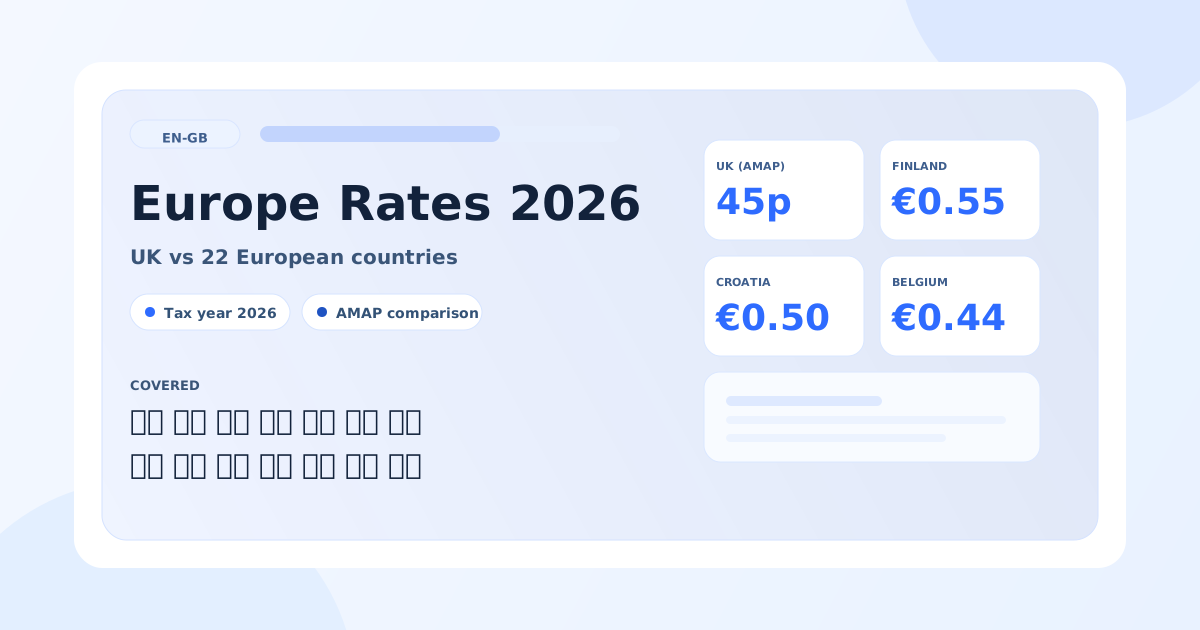
How UK mileage rates compare to 22 other European countries in 2026 — from Finland's €0.55/km to Luxembourg's €0.30/km — and what matters for cross-border claims.
Since leaving the EU, UK businesses that send employees across the Channel face a more fragmented landscape than ever. Each European country sets its own mileage reimbursement rate, its own rules on what qualifies as business travel, and its own stance on commuting deductions. If your workforce drives in more than one jurisdiction, you need to know how these rates compare — both to justify your reimbursement policy and to keep your cross-border claims defensible.
This guide sets out the 2026 mileage rates for 23 European countries alongside the UK, explains where they diverge, and highlights the practical traps that catch UK businesses operating on the continent.
How the UK compares: AMAP in European context
The UK’s Approved Mileage Allowance Payments (AMAP) rate is 45p per mile for the first 10,000 business miles and 25p per mile thereafter. Converting to kilometres for a fair comparison with continental rates, that works out to approximately 28p/km (or roughly €0.33/km) at the lower band, and about 52p/km (roughly €0.62/km) at the upper band.
At the 45p rate, the UK is one of the most generous countries in Europe for per-mile reimbursement. Only Finland’s €0.55/km comes close in absolute terms, and the Nordics generally cluster at the top of the table. But the picture changes once you cross 10,000 miles: the 25p rate drops the UK to the middle of the pack — comparable to Luxembourg or the Czech Republic.
This two-tier structure is unusual. Most European countries apply a single flat rate per kilometre regardless of annual volume. That simplicity has a practical advantage: continental employees and their employers never need to track a cumulative threshold.
For a full breakdown of UK-specific AMAP rules, thresholds, and claim workflows, see HMRC Mileage Rates 2026.
Full comparison table: 2026 rates
The table below lists 23 European countries plus the UK, sorted by approximate euro-equivalent rate from highest to lowest. Where a country uses a non-euro currency, the conversion uses March 2026 mid-market rates for illustration only — official claims are always filed in local currency.
| Country | Rate | Currency | EUR equivalent | Rate model | Commute treatment |
|---|---|---|---|---|---|
| United Kingdom | 45p/25p per mile | GBP | ≈ €0.62/€0.33 per km | Two-tier (10k mile threshold) | Not deductible |
| Finland | €0.55/km | EUR | €0.55 | Flat per-km | Not deductible |
| Austria | €0.50/km | EUR | €0.50 | Flat per-km (amtliches Kilometergeld) | Separate commuter allowance (Pendlerpauschale) |
| Croatia | €0.50/km | EUR | €0.50 | Flat per-km | Not deductible |
| Norway | NOK 3.50/km | NOK | ≈ €0.31 (first 10k km); higher effective value via tax deduction | Flat per-km + deduction | Deductible above NOK threshold |
| Belgium | €0.4449/km | EUR | €0.4449 | Indexed annually (CPI-linked) | Tax-free employer reimbursement allowed |
| Sweden | SEK 2.50/km | SEK | ≈ €0.22 (reimbursement); higher via tax deduction | Flat per-km + tax deduction | Deductible (capped, distance-based) |
| Denmark | DKK 3.79/km (first 20k km) | DKK | ≈ €0.51 | Two-tier (20k km threshold) | Not deductible |
| Iceland | ISK 87/km | ISK | ≈ €0.58 | Flat per-km | Not deductible |
| Switzerland | CHF 0.70/km | CHF | ≈ €0.73 | Flat per-km (varies by canton) | Deductible (capped by canton) |
| Ireland | €0.35–€0.22/km | EUR | €0.35–€0.22 | Tiered by engine CC and annual km | Not deductible |
| Germany | €0.30/km | EUR | €0.30 | Flat per-km (Dienstreisepauschale) | Separate commuter flat (€0.30–€0.38/km) |
| France | €0.13–€0.60/km | EUR | varies | Scale based on fiscal HP + annual km | Not deductible (unless frais réels elected) |
| Netherlands | €0.23/km | EUR | €0.23 | Flat per-km (tax-free reimbursement) | Tax-free at same €0.23/km rate |
| Italy | Per ACI tables | EUR | varies by model | Per-vehicle model (ACI cost tables) | Not deductible |
| Spain | €0.26/km | EUR | €0.26 | Flat per-km | Not deductible |
| Portugal | €0.36/km | EUR | €0.36 | Flat per-km | Not deductible |
| Poland | PLN 0.89/km | PLN | ≈ €0.21 | Flat per-km (by engine size) | Not deductible |
| Czech Republic | CZK 5.60/km + fuel | CZK | ≈ €0.23 (base) | Base rate + fuel cost reimbursement | Not deductible |
| Estonia | €0.30/km | EUR | €0.30 | Flat per-km (capped monthly) | Tax-free if justified |
| Slovenia | €0.43/km | EUR | €0.43 | Flat per-km | Not deductible |
| Hungary | HUF 15/km | HUF | ≈ €0.04 (nominal) | Flat per-km (very low nominal rate) | Not deductible |
| Slovakia | Per ministry rates | EUR | ≈ €0.24 | Ministry-published rate + fuel | Not deductible |
| Luxembourg | €0.30/km | EUR | €0.30 | Flat per-km | Not deductible |
| Malta | €0.25/km | EUR | €0.25 | Flat per-km | Not deductible |
| Cyprus | €0.30–€0.42/km | EUR | varies | Tiered by engine CC | Not deductible |
| Greece | €0.30/km | EUR | €0.30 | Flat per-km | Not deductible |
Notes on the table: France and Italy use vehicle-specific models, so a single rate per kilometre does not fully capture what employees can claim. Ireland operates engine-capacity bands that shift the rate significantly. Switzerland’s rate varies by canton; CHF 0.70/km is the commonly applied federal guideline. Denmark’s rate drops after 20,000 km per year, similar in principle to the UK’s 10,000-mile split.
Regional breakdown
Nordics: Sweden, Norway, Finland, Denmark, Iceland
The Nordics consistently set the highest mileage rates in Europe, reflecting higher vehicle running costs, fuel taxes, and insurance premiums in these markets.
Finland leads with a straightforward €0.55/km flat rate — no thresholds, no vehicle-model tables. It is the simplest high-rate system in Europe. Iceland is comparable at roughly €0.58/km equivalent when converted from Icelandic kronur, though the rate is set in ISK and fluctuates with exchange rates.
Denmark uses a two-tier model conceptually similar to the UK’s AMAP structure: DKK 3.79/km for the first 20,000 km per year, dropping to DKK 2.23/km above that. The threshold is more generous than the UK’s 10,000-mile mark (approximately 16,000 km), so Danish employees reach the lower band less often.
Norway and Sweden deserve special attention because their systems blend per-kilometre reimbursement with separate tax deductions. In Norway, the employer can reimburse at NOK 3.50/km tax-free, but employees can also claim a deduction for commuting above a threshold — a concept foreign to UK tax rules. Sweden’s SEK 2.50/km reimbursement rate looks low, but the generous tax deduction for driving costs significantly increases the effective benefit.
DACH region: Germany, Austria, Switzerland
These three countries illustrate three quite different approaches sitting side by side.
Germany applies €0.30/km for business travel (Dienstreisepauschale), which is straightforward. Where it gets complicated is the separate commuter allowance: €0.30/km for the first 20 km of a home-to-work commute, rising to €0.38/km from km 21 onwards. This is a tax deduction, not a reimbursement — a distinction that matters for cross-border payroll.
Austria sets a generous €0.50/km flat rate (amtliches Kilometergeld) that covers all vehicle costs. Separately, employees can claim a commuter flat-rate tax allowance (Pendlerpauschale) based on distance and public transport availability. The combined benefit makes Austria one of the most driver-friendly tax regimes in Europe.
Switzerland is the outlier. At approximately CHF 0.70/km (roughly €0.73/km), the Swiss federal guideline rate is the highest in Europe — exceeding even the UK’s upper-band AMAP when converted. However, rates vary by canton, actual costs can be claimed if higher, and commuting is deductible up to cantonal caps. The system is decentralised in a way that has no UK equivalent.
Benelux: Belgium, Netherlands, Luxembourg
Belgium is notable for its annually indexed mileage rate, which adjusts with the consumer price index. For 2026, the rate is €0.4449/km — a precise figure that reflects the indexation formula. This automatic adjustment means Belgian employees never face the situation UK drivers have endured since 2011, where the AMAP rate has remained frozen despite inflation.
The Netherlands applies a simple €0.23/km tax-free reimbursement. The distinctive feature is that this rate also applies to commuting: Dutch employers can reimburse home-to-work travel at €0.23/km without it being treated as taxable income. For UK businesses with Dutch operations, this is a significant difference from UK rules, where ordinary commuting is never claimable.
Luxembourg sets a modest €0.30/km, in line with several other continental countries. No commuting deduction applies.
Mediterranean: Spain, Portugal, Italy, Cyprus, Malta, Greece
Mediterranean countries generally apply simpler, lower flat rates. Spain (€0.26/km), Malta (€0.25/km), and Greece (€0.30/km) all use single per-kilometre figures with no thresholds or vehicle-model adjustments.
Portugal sits slightly higher at €0.36/km — a recent increase that brought it above the regional average.
Italy is the exception. Rather than a flat rate, Italy uses cost tables published annually by the Automobile Club d’Italia (ACI). The reimbursement depends on the specific vehicle make, model, and engine type, with rates varying significantly between a small city car and a large saloon. For UK businesses with Italian operations, this means mileage reimbursement requires knowing exactly which vehicle each employee drives — a level of granularity that AMAP does not demand.
Cyprus applies tiered rates based on engine capacity, ranging from roughly €0.30/km for smaller engines to €0.42/km for larger ones. This is a simpler version of the Irish model.
Eastern Europe: Poland, Croatia, Slovenia, Estonia, Czech Republic, Slovakia, Hungary
Eastern European rates vary more than you might expect. Croatia and Slovenia both sit at the higher end — €0.50/km and €0.43/km respectively — rates that rival the Nordics.
Estonia applies €0.30/km with a monthly cap, and has the unusual feature that commuting reimbursement can also be tax-free if the employer can justify it. Poland (PLN 0.89/km, roughly €0.21/km) and the Czech Republic (CZK 5.60/km base plus fuel reimbursement) sit at the lower end.
Hungary has the lowest nominal rate in Europe at HUF 15/km (approximately €0.04/km), though this is supplemented by other allowances in practice.
Slovakia publishes ministry rates annually and adds fuel cost reimbursement on top, creating a composite figure that varies with fuel prices.
Commuting: where the rules diverge
For UK businesses, the rule is simple: ordinary commuting to a permanent workplace is not deductible and cannot be reimbursed tax-free under AMAP. This aligns with most European countries — Spain, Italy, France, Poland, and many others take the same position.
But several countries break from this pattern:
- Netherlands — employers can reimburse commuting at €0.23/km tax-free, the same rate as business travel. No distinction is drawn between the two for reimbursement purposes.
- Norway — commuting costs above a threshold (currently NOK 14,400 per year) are tax-deductible. Employees with long commutes benefit significantly.
- Austria — the Pendlerpauschale provides a tax-free commuter allowance based on distance and whether public transport is reasonably available.
- Germany — the Entfernungspauschale (distance allowance) allows a deduction for commuting at €0.30/km for the first 20 km and €0.38/km beyond that, regardless of transport mode.
- Sweden — commuting costs are deductible above a threshold of SEK 11,000, but only if driving saves at least two hours per day compared to public transport.
- Switzerland — commuting is deductible up to cantonal caps, typically CHF 3,000–7,000 per year.
- Estonia — employer-paid commuting can be tax-free if the employer provides written justification.
If you employ people across multiple countries, your reimbursement policy needs to account for these differences. Applying UK commuting rules uniformly across European operations will either short-change employees in countries with commuting allowances or create compliance gaps.
Countries with complex models the UK does not have
Three European countries use mileage rate structures that differ fundamentally from the UK’s simple per-mile approach.
France calculates its mileage allowance (barème kilométrique) based on the vehicle’s fiscal horsepower (chevaux fiscaux) and total annual kilometres driven. The resulting rate ranges from approximately €0.13/km for high-mileage, low-power vehicles to over €0.60/km for low-mileage, high-power ones. Employees must elect frais réels (actual expense deduction) on their tax return rather than the standard flat deduction — an active choice that has no UK equivalent.
Italy bases reimbursement on ACI cost-per-kilometre tables that are specific to each vehicle model and engine variant. An employee driving a Fiat 500 claims a different rate from one driving an Alfa Romeo Giulia. Employers must reference the correct table entry, making mileage administration significantly more involved than in the UK.
Ireland uses engine capacity bands: rates differ depending on whether the vehicle is 0–1,200 cc, 1,201–1,500 cc, or over 1,500 cc, with further tiers based on annual distance. The structure means two employees driving the same route but in different cars receive different reimbursements — a concept AMAP deliberately avoids by using a single flat rate for all cars.
Cross-border tips for UK businesses
If your employees drive for business across European borders, keep these practical points in mind:
Record trips per country. Your mileage log should capture which country each journey took place in. If a single trip crosses borders — say, driving from Calais to Brussels — record the segments separately where possible. This matters because different jurisdictions may require records in different formats, and auditors will want to see country-level breakdowns.
Apply the correct rate per jurisdiction. For UK tax purposes, AMAP rates apply to all business journeys in your own vehicle regardless of where you drive. But if you are reimbursing employees under local employment contracts in European countries, the local rate applies. Running two parallel rate structures — AMAP for UK-contracted staff and local rates for locally contracted staff — is common for businesses operating cross-border.
Account for currency differences. Reimbursements to UK employees should be in sterling, using a defensible exchange rate. HMRC accepts rates from reputable sources — the Bank of England spot rate on the date of travel, or HMRC’s own published exchange rates, are both reasonable choices. Document which rate source you use and apply it consistently.
Keep fuel receipts for complex jurisdictions. In countries like the Czech Republic and Slovakia where fuel costs are reimbursed separately on top of a base rate, employees need to retain fuel receipts. This is not required under AMAP, so UK-based staff may not be accustomed to keeping them.
Review annually. European mileage rates change more frequently than AMAP. Belgium indexes annually. Germany, Austria, and the Nordics review periodically. France updates its barème each spring. Build an annual review into your finance calendar to ensure your reimbursement policy stays current.
Track every jurisdiction in one place
Managing mileage across multiple European countries does not need to mean multiple spreadsheets and manual currency conversions. A mileage tracking tool that captures GPS data, classifies trips by purpose, and tags the country automatically removes much of the administrative overhead.
MileTrack records journeys in the background, classifies them as business, commute, or personal, and produces export-ready reports with the fields tax authorities expect — including country-level breakdowns for cross-border operations. See the UK product page at miletrack.app/en-gb.
Tax note: this article is educational and reflects rates published as of March 2026. Mileage rules vary by country and change periodically. Always confirm current rates with the relevant tax authority or a qualified tax adviser before filing claims.
Freshness note
Rates verified against official government sources as of March 2026. Always confirm with the relevant tax authority before filing.
Official sources
Ready to try MileTrack?
Get free access now or open the UK product page for a quick overview of the workflow.
FAQ
How does the UK AMAP rate compare to European mileage rates?
The UK's 45p per mile (roughly 52p/km or €0.62/km) for the first 10,000 miles is one of the highest effective rates in Europe. Only Finland (€0.55/km), Austria and Croatia (€0.50/km each) come close among eurozone countries. However, the UK rate drops to 25p per mile after 10,000 miles.
Which European country has the most generous mileage rate?
In absolute euro terms, Finland leads at €0.55/km, followed by Austria and Croatia at €0.50/km each, and Belgium at €0.4449/km (indexed). The Nordics generally have higher rates.
Do UK mileage rules apply when driving for business in Europe?
UK AMAP rates apply to journeys in your own vehicle for UK tax purposes regardless of where you drive. However, if you are reimbursed under a local European rate by a European employer or client, different rules may apply. Always keep detailed records of cross-border trips.
Is commuting deductible anywhere in Europe?
Yes, in several countries. Norway, Sweden, Austria, Switzerland, and Estonia all allow some form of commuting deduction or tax-free commuting reimbursement, though often with caps or conditions. The UK, like most countries, treats ordinary commuting as non-deductible.